
How Tablet Security Display Stands Balance Customer Access and Theft Prevention
Tablet Alarm System Security Display Stand solutions reflect a growing change in electronics retail: stores need to make devices available for hands-on testing without overlooking security. As open displays become more common, balancing customer access with theft prevention is becoming a practical challenge for modern retail environments.
Open Displays Create New Security Challenges
Tablets are designed for interaction. Customers often want to test touchscreen responsiveness, explore applications, compare screen quality, and evaluate device functions before making a purchase decision. Keeping these products behind locked cabinets can limit access and make product demonstrations less convenient.
Open displays offer a different approach. Devices remain visible and accessible, allowing customers to explore features at their own pace. However, this arrangement also introduces risks, particularly in busy shopping centers, electronics stores, exhibition spaces, and service counters where staff cannot monitor every device continuously.
The challenge is not simply to prevent unauthorized removal. Retail spaces must also preserve a natural customer experience. Excessively restrictive security measures may discourage interaction, while insufficient protection can increase the risk of loss and equipment damage.
How Integrated Security Supports Customer Access
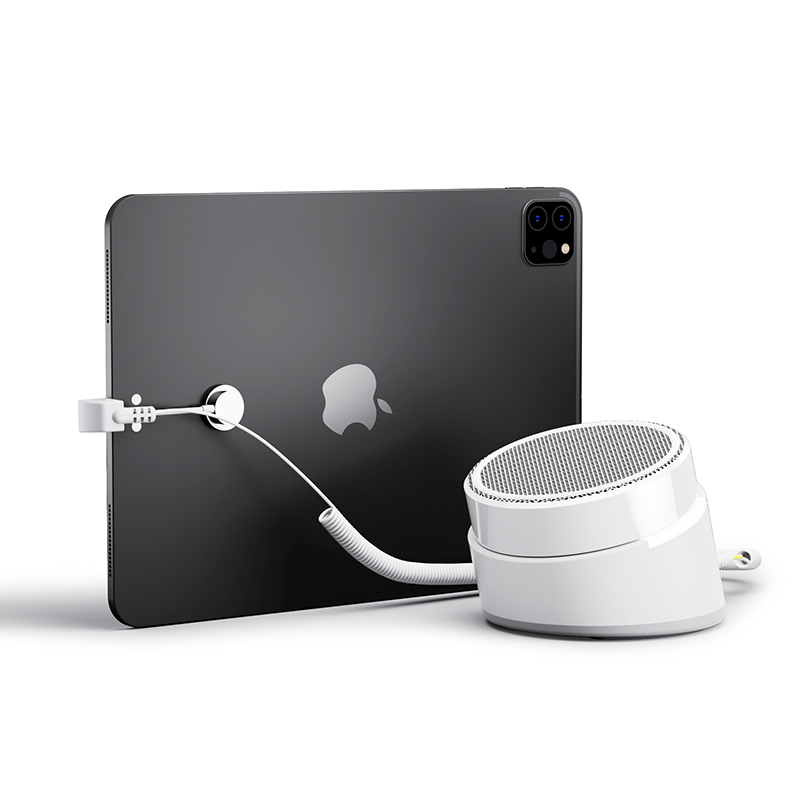
A modern Tablet Alarm System Security Display Stand combines device presentation with protective functions. Depending on its configuration, the system may incorporate a mounting structure, security sensor, alarm unit, and cable connections to help keep the tablet accessible while reducing the risk of unauthorized removal.
The main advantage of this approach is that security becomes part of the display rather than a separate obstacle. Customers can interact with the device, while the equipment provides an additional layer of protection.
Several design considerations influence how effectively these systems work:
Physical Stability and Secure Mounting
A stable mounting structure helps keep tablets in their intended position during repeated demonstrations. The mounting method should suit the device dimensions, installation surface, and expected usage conditions.
Poorly positioned supports can make devices uncomfortable to use or interfere with access to buttons and connectors. Good structural design therefore needs to consider both stability and usability.
Alarm Functions and Device Monitoring
Electronic alarms can alert staff when a protected device is disconnected or disturbed in a way that triggers the system. The exact response depends on the sensor arrangement and alarm configuration.
Alarm systems should be evaluated for trigger sensitivity, reset procedures, power requirements, and compatibility with the displayed device. Clear operating procedures also help staff respond consistently when an alert occurs.
Cable Management and Charging
Tablets displayed throughout the day may require continuous charging. Unorganized cables can create clutter, interfere with customer interaction, and increase the likelihood of accidental disconnection.
Integrated cable routing can keep the display area neater and help protect connections from unnecessary strain. Where charging is included, power requirements and cable compatibility should be checked before installation.
Comparing Common Tablet Display Approaches
Different display methods offer different balances between accessibility, protection, and convenience.
| Display Approach | Customer Access | Security Considerations | Common Application |
|---|---|---|---|
| Locked glass cabinet | Limited direct access | Physical enclosure restricts handling | High-value products with limited demonstrations |
| Basic open stand | Easy interaction | Relies heavily on supervision and separate security measures | Low-risk demonstration areas |
| Alarm-equipped display stand | Open interaction with added protection | Depends on alarm configuration and mounting strength | Electronics stores and service counters |
| Integrated display and charging system | Convenient extended demonstrations | Requires suitable power and cable management | Interactive product zones |
No single design suits every location. The appropriate choice depends on the value of the devices, customer traffic, staffing arrangements, store layout, and the level of interaction expected.
Retail Layout Also Influences Security
Security performance is affected by more than the display equipment itself. Placement, visibility, and staff workflow can influence how well a protected device is managed.
Displays positioned near staffed counters may be easier to supervise than those placed in isolated corners. Clear sightlines can help staff notice unusual activity without making customers feel closely watched. Adequate spacing also allows visitors to test devices without crowding neighboring displays.
A Tablet Alarm System Security Display Stand should therefore be considered alongside the wider store layout. Equipment selection and placement work best when they reflect actual operating conditions rather than appearance alone.
Retail teams can assess several practical questions before arranging a display area:
These checks help identify potential problems before a display becomes part of daily operations.
Manufacturing and Design Capabilities Support Continued Development
The development of retail security equipment increasingly involves coordination between mechanical structures, electronic components, and user experience.
Ningbo Pyets Electronic Technology Co., Ltd has worked in electronic anti-theft devices and retail display equipment since 2011. Its product range includes anti-theft hooks, mobile phone tray display stands, steel wire pullers, and open display systems for electronic products.
The company operates injection molding machines, precision punching machines, automated production lines, mold-processing equipment, and testing instruments. Its technical team includes industrial designers, structural designers, software and hardware developers, and testers. The company also reports more than 30 invention and utility patents across its anti-theft product series.
These capabilities illustrate the range of disciplines involved in developing display equipment. Plastic components affect appearance and assembly, metal structures contribute to mechanical stability, and electronic systems determine how alarms operate. Coordinating these elements is important when a product must withstand frequent public use.
What to Consider as Retail Security Evolves
As interactive retail expands, tablet protection is likely to remain closely connected to convenience and presentation quality. Future development may place greater emphasis on modular mounting, easier installation, improved cable organization, and compatibility with different device sizes.
However, adding more features does not automatically produce a better display. Every additional function needs to serve a clear purpose without making the equipment difficult to maintain or operate. Alarm reliability, physical durability, accessibility, and straightforward daily management remain essential considerations.
Retail environments also differ significantly in risk. A staffed demonstration counter may require a different level of protection from an unattended display in a high-traffic public area. Assessing these differences helps prevent both inadequate protection and unnecessary restrictions on customer access.
Balancing Protection with a Better Product Experience
Effective tablet security depends on finding a workable balance between open interaction and controlled access. Stable mounting, appropriately configured alarms, organized charging, and thoughtful placement can help reduce operational risks without turning product demonstrations into a restrictive experience.
As electronic retail continues to prioritize hands-on engagement, the Tablet Alarm System Security Display Stand represents an approach that brings product presentation and security into a shared design. Ningbo Pyets Electronic Technology Co., Ltd's experience in anti-theft devices and open display equipment reflects the broader industry movement toward retail systems that consider protection, usability, and everyday store management together.
Previous:No News
Send Inquiry


X
We use cookies to offer you a better browsing experience, analyze site traffic and personalize content. By using this site, you agree to our use of cookies.
Privacy Policy